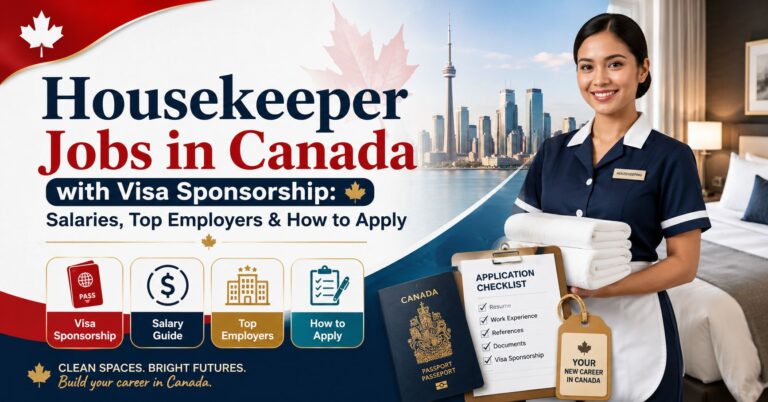
Housekeeping Supervisor Jobs in Vancouver with Visa Sponsorship
If you’re searching for a hospitality career that pays well, gets you out of your current country, and comes with a clear path to Canadian permanent residency, the housekeeping supervisor role in Vancouver is one of the most overlooked goldmines on the market.
The position pays between $47,902 and $78,177 per year, with an average around $65,530 in Vancouver, British Columbia depending on the hotel chain and your experience level. Several Vancouver hotels are actively offering visa sponsorship to qualified foreign candidates — meaning your employer handles the LMIA paperwork, you get a Canadian work permit, and within a few years you can apply for permanent residency through Express Entry or British Columbia’s Provincial Nominee Program. ERI
Below is the exact playbook: what the job involves, how much you’ll earn, which Vancouver hotels sponsor visas, the LMIA process step-by-step, and where to apply right now.
High-Paying Family Caregiver Jobs in Canada with LMIA Sponsorship: 2026 Salaries, PR Pathway &…

Waiter and Waitress Jobs in Canada with Visa Sponsorship: Real Pay, Top Employers

Nursing Jobs in Canada for Foreign RNs 2026: IEN Licensing Pathway, NCLEX, Salaries Up…

Construction Site Supervisor Jobs in Canada with Visa Sponsorship: 2026 Salaries Up to $98,000,…

Dairy Farm Foreman Jobs in Canada with LMIA Sponsorship: 2026 Salaries Up to $36/Hour,…

Top Healthcare Jobs in Canada with Visa Sponsorship: 2026 Salaries (Up to $300,000), Express…
Why Vancouver Is a Sweet Spot for Hospitality Workers
Vancouver runs one of Canada’s busiest tourism economies. Between Stanley Park, the cruise terminal, the Whistler corridor, and year-round international business travel, the city’s hotels rarely slow down. That demand creates a chronic shortage of supervisory hospitality staff — and where there’s a shortage, employers turn to foreign workers.
For housekeeping supervisors specifically, three things make Vancouver stand out:
- Higher than average wages. BC’s housekeeping supervisor salaries beat most other provinces. Vancouver pulls roughly $57,726 per year on average based on Indeed’s reported salary data, compared to $42,900 across Canada overall. Indeed
- An open visa pipeline. British Columbia’s Provincial Nominee Program runs streams that have historically included tourism and hospitality workers, and the federal Temporary Foreign Worker Program treats Vancouver as a priority hiring region.
- A pathway to permanent residency. Time worked under an LMIA-backed permit earns you Canadian work experience — the single biggest factor in qualifying for permanent residency through Express Entry’s Canadian Experience Class.
In other words: this is one of the few entry-level supervisory jobs where you can land in Canada, stabilize quickly, and convert to PR inside three years.
What a Housekeeping Supervisor Actually Does
Forget the job title for a second. The role is part operations manager, part quality inspector, part HR coordinator. On a typical shift, you will:
- Assign rooms and zones to housekeeping attendants based on occupancy
- Inspect cleaned rooms before they’re released to guests
- Train new hires on cleaning protocols, chemical handling, and brand standards
- Manage linen, supply, and amenity inventory (and flag shortages before they become problems)
- Log maintenance defects — broken fixtures, stained carpets, malfunctioning HVAC — and route them to engineering
- Handle the lost-and-found system for guest belongings
- Coach underperforming staff and escalate issues to the executive housekeeper
- Resolve guest complaints related to cleanliness or in-room amenities
- Schedule shifts, manage attendance, and balance labor costs against occupancy forecasts
It’s a leadership job that demands a sharp eye, a calm temperament, and the ability to think on your feet when a 200-room hotel is checking out at 11 AM and checking back in by 3 PM.
How Much You’ll Actually Earn in Vancouver
Here’s where the role becomes interesting. Different sources track different segments of the market, so here’s the full picture for Vancouver and BC:
| Source | Average Salary | Range |
|---|---|---|
| Indeed Canada | $57,726/yr | Based on 17 Vancouver workers |
| ERI SalaryExpert | $65,530/yr | $47,902 – $78,177 |
| Jooble (Vancouver) | $57,913/yr | $28 – $32/hour |
| Talent.com (Canada-wide) | $49,092/yr | Up to $106,052 senior level |
Some boutique and luxury properties in Vancouver’s West End post hourly rates of $28 to $32 per hour for experienced housekeeping supervisors leading housekeeping operations at boutique hotels, which translates to roughly $58,000 to $66,000 annually before tips, shift differentials, or bonuses. Entry-level positions in Canada start around $46,800 per year, while the most experienced workers can earn up to $106,052.
Add the fact that many sponsoring employers cover relocation assistance, temporary housing, and sometimes even health insurance during your first months, and the effective compensation climbs higher.
Visa Sponsorship Explained (Without the Confusion)
Visa sponsorship in Canada doesn’t mean what most people think. The employer doesn’t issue your visa — the Canadian government does. What sponsorship actually means is that a Canadian employer commits to hiring you and agrees to do the paperwork that proves the federal government should let you in.
That paperwork is called an LMIA — Labour Market Impact Assessment.
Here’s how it works in plain English: before a Canadian employer can hire a foreign worker, they have to convince the government that no Canadian citizen or permanent resident was available to take the job. The LMIA is an official document issued by the Canadian government that allows employers to hire foreign workers when no suitable Canadian citizen or permanent resident is available for the position. Once Service Canada issues a positive LMIA, you take that document, attach it to your work permit application, and submit everything to IRCC (Immigration, Refugees and Citizenship Canada). Mapleleafvisa
A few things worth knowing:
- The employer pays the LMIA fee, not you. If a “recruiter” asks you to pay for an LMIA, walk away. It’s illegal for the worker to fund it, and it’s a common scam pattern.
- The LMIA process typically takes 2 to 4 months and is paid by the employer depending on the stream and the employer’s track record.
- A positive LMIA is not a visa. It is essentially a government endorsement that the employer’s job offer is legitimate; once a positive LMIA is obtained, the foreign worker must separately apply for a work permit through IRCC.
The Visa Pathways That Actually Lead Somewhere
You have four realistic routes to working in Vancouver as a housekeeping supervisor. The right one depends on your timeline and long-term plans.
1. Temporary Foreign Worker Program (TFWP)
This is the standard LMIA-based route. The employer applies for an LMIA, you apply for an employer-specific work permit, and you start working in Vancouver. The permit is tied to that employer, which means switching jobs requires a new permit. The advantage: it works, it’s the most common path, and time under TFWP counts toward your Canadian Experience Class application later.
2. International Mobility Program (IMP)
This is the LMIA-exempt route. Most housekeeping supervisor positions don’t qualify for IMP on their own, but certain employers with intra-company transfer arrangements or workers from countries with reciprocal agreements (Australia, Ireland, the UK via International Experience Canada) can skip the LMIA entirely. Faster processing, but narrower eligibility.
3. Provincial Nominee Program (BC PNP)
British Columbia operates streams under its Provincial Nominee Program that have historically targeted tourism and hospitality workers. After working for a BC employer for a qualifying period under TFWP, you can apply for nomination. A provincial nomination adds 600 points to your Express Entry profile, virtually guaranteeing selection.
4. Express Entry (Canadian Experience Class)
After 12 months of full-time skilled work experience in Canada, you become eligible for the Canadian Experience Class under Express Entry. From Invitation to Apply to PR confirmation, the process takes approximately six months for most applicants. Combined with your sponsored work permit history, the road from “newly arrived housekeeping supervisor” to “Canadian permanent resident” can realistically be completed in 24 to 36 months.
Who Qualifies for Sponsorship
Employers in Vancouver are selective, but the bar is reasonable. Here’s what they generally look for:
- Two to five years of housekeeping experience, ideally with at least one year in a supervisory or team-lead capacity
- English proficiency — most hotels expect CLB 5 to 7 (roughly equivalent to IELTS 5.0 to 6.5)
- A secondary school diploma at minimum; hospitality certificates or college diplomas in tourism management strengthen the application significantly
- Clean criminal record (police clearance certificates required from every country you’ve lived in for six months or more since age 18)
- Medical exam clearance from an IRCC-approved panel physician
- Genuine intent and the ability to demonstrate it — Canada wants workers who will actually do the job
Hotels also screen for soft skills: leadership presence, attention to detail, the ability to manage staff from diverse cultural backgrounds, and a service-first mindset. If your resume shows progression — room attendant to senior attendant to floor supervisor — that’s far more persuasive than scattered short stints.
Hotels in Vancouver That Sponsor Visas
While employer participation changes constantly, these hotel groups have a history of LMIA-backed hiring in the Vancouver market:
- Pan Pacific Vancouver — Posts housekeeping supervisor roles directly on Indeed, with pay listed at $19.00 to $22.00 per hour for recent listings Indeed
- Fairmont Hotels & Resorts — Including Fairmont Pacific Rim, Fairmont Waterfront, and Fairmont Hotel Vancouver
- Marriott International — Multiple Vancouver properties under Marriott, Sheraton, and Delta brands
- Hilton — Hilton Vancouver Downtown and Hilton Vancouver Metrotown
- Four Seasons Hotel Vancouver
- Shangri-La Vancouver
- Boutique and Independent Hotels — Properties in the West End and Yaletown frequently post supervisor roles with sponsorship potential
The bigger chains have established immigration counsel and tend to handle LMIA paperwork as a routine process. Smaller boutique hotels may sponsor but take longer to navigate the paperwork — apply to both.
The Step-by-Step Application Process
Here’s the realistic sequence from application to first paycheck:
Step 1: Find a real LMIA-backed posting. Use Indeed Canada filtered by “visa sponsorship” and “Vancouver, BC.” Verify the employer is legitimate before applying — search the company name on the Better Business Bureau, LinkedIn, and the Government of Canada’s list of approved employers.
Step 2: Apply with a Canadian-formatted resume and cover letter. One page, reverse chronological, achievement-driven bullets. Avoid photos and personal details (date of birth, marital status) — Canadian employers don’t want them, and including them can get your application set aside.
Step 3: Interview. Expect Zoom or Microsoft Teams. Practice behavioral questions (“Tell me about a time you handled an underperforming team member”) and have specific examples ready.
Step 4: Job offer and LMIA application. The employer applies to Service Canada for the LMIA. This takes 2 to 4 months. You stay in your home country during this period.
Step 5: Work permit application. Once the LMIA is positive, you apply to IRCC for the work permit. Include your job offer, LMIA confirmation, passport, biometrics, medical exam, and police clearance. Processing time varies by country — typically 6 to 16 weeks.
Step 6: Arrival and onboarding. You land in Vancouver, present your documents at the port of entry, receive your work permit, and begin work.
Step 7: PR preparation. Start documenting your work hours and pay stubs from day one. You’ll need them for your eventual Canadian Experience Class or BC PNP application.
Common Mistakes That Kill Applications
A few patterns sink otherwise strong candidates:
- Generic resumes. Recruiters spot template resumes in seconds. Customize every application with the property name, the specific role, and one or two genuine references to the brand.
- Paying anyone for a job offer. Legitimate LMIA jobs are never found on platforms that require payment to unlock job details — if a posting asks for money to connect you to the employer, it’s a lead-generation scam. Ircc
- Inflated experience claims. Hotels verify references. Inconsistencies between your resume and verification calls end the process immediately.
- Skipping the language test. IELTS or CELPIP results aren’t always required at the application stage, but you’ll need them for the work permit. Book the test early.
- Ignoring smaller properties. Independent and boutique hotels are often more open to sponsoring foreign supervisors than the household-name chains, simply because they have fewer local applicants.
Frequently Asked Questions
How long does the entire process take from application to arrival in Vancouver?
Realistically, six to ten months. LMIA: 2 to 4 months. Work permit: 2 to 4 months. Add buffer for medicals, biometrics, and document collection.
Do I need to speak French?
No. Vancouver is overwhelmingly English-speaking. French is helpful for some federal Express Entry programs but not required for the housekeeping supervisor role.
Can my spouse work in Canada too?
Yes. Spouses of LMIA-backed work permit holders typically qualify for an open work permit, allowing them to work for any employer in Canada.
Will my children get free education?
Yes. Minor dependents of work permit holders generally have access to publicly funded K-12 education in BC at no cost.
How much money do I need to bring?
Vancouver is expensive. Budget at least CAD $3,000 to $5,000 for your first month: rent deposits, transportation, initial groceries, and contingency funds. Many sponsoring employers offer temporary housing for the first few weeks.
Is housekeeping supervisor a route to Canadian citizenship?
Yes, indirectly. Permanent residency obtained through Express Entry or BC PNP after working as a housekeeping supervisor opens the door to citizenship after meeting residency requirements (currently three years of physical presence in Canada within a five-year window).
Where to Apply Right Now
The fastest way to find current housekeeping supervisor roles in Vancouver with visa sponsorship is through Indeed Canada, which consolidates active LMIA-backed postings from hotels across British Columbia. The platform lets you filter by location, employer, and sponsorship status — and the listings are updated daily. There are currently 722 visa sponsorship housekeeping supervisor jobs available on Indeed Canada, including listings from Pan Pacific Vancouver and other major Vancouver properties.
Before applying, prepare three things:
- A Canadian-format resume (one page, no photo, achievement-driven)
- A short cover letter customized to each property
- A government-issued ID, passport scan, and any existing language test results
Apply to multiple properties — most successful applicants submit 15 to 30 applications before landing the right offer. Track your applications, follow up after 10 business days, and treat the job search like a full-time project until you receive the offer letter that changes your life.
Vancouver’s hospitality industry needs supervisors. The visa pathway exists. The salary is real. The only question left is whether you’ll send the first application this week.
👉 Click here to apply now: Housekeeping Supervisor Jobs with Visa Sponsorship in Vancouver, BC — Indeed Canada