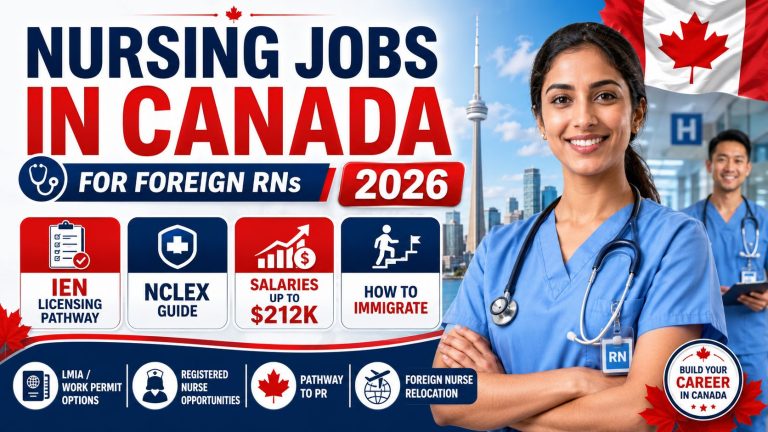
Top Healthcare Jobs in Canada with Visa Sponsorship: 2026 Salaries (Up to $300,000), Express Entry Priority & How to Apply
There is an immigration advantage available to foreign healthcare workers in Canada in 2026 that almost no other category of foreign worker can access. It is not a special visa. It is not a secret program. It does not require connections or extraordinary qualifications. And yet, it has the practical effect of cutting years off the typical permanent residency timeline and lowering the eligibility threshold by what amounts to forty or fifty points compared to the general immigration system.
It is the Express Entry healthcare category-based selection — and it is the single most important fact that any foreign nurse, physician, pharmacist, physiotherapist, medical lab technologist, or allied health professional considering Canada needs to understand before doing anything else.
If you have been told that Canadian immigration is fiercely competitive, that the comprehensive ranking system favours candidates with perfect English scores and Canadian degrees, that the wait from application to permanent residency is years long for most foreign workers, almost everything you have heard is true — for most categories of worker. Healthcare is the exception. Healthcare workers have their own draws. Healthcare workers face their own lower threshold. Healthcare workers move through the system in months rather than years when their profiles are positioned correctly. And the salaries waiting for them on the other side of that process are not modest. Registered nurses in Canada earn an average of $90,073 per year, with top earners reaching $212,503. Specialist physicians clear $300,000 annually. Pharmacists routinely earn over $100,000.
This guide is going to walk through every piece of this picture honestly. We will cover the Express Entry healthcare category in operational detail, including the most recent draw data, the eligible occupations list, and the CRS thresholds that have applied throughout 2025 and 2026. We will explain what each major healthcare role actually pays across Canadian provinces. We will discuss the licensing maze that internationally trained healthcare workers must navigate before they can practise. We will identify the employers actively sponsoring foreign healthcare professionals. And we will close with the realistic application playbook that takes a foreign-trained healthcare worker from initial decision to Canadian permanent residency.
But first, you need to understand the immigration mechanic that makes the entire rest of this picture possible. Almost no other article explains this clearly, and getting it right is the difference between landing in Canada within twelve months and waiting in the general Express Entry pool for years.

Dairy Farm Foreman Jobs in Canada with LMIA Sponsorship: 2026 Salaries Up to $36/Hour,…

Construction Site Supervisor Jobs in Canada with Visa Sponsorship: 2026 Salaries Up to $98,000,…

Unskilled Jobs in Canada with Visa Sponsorship 2026: Salaries Up to $28/Hour, LMIA Pathway…

Security Guard Jobs in Canada with Visa Sponsorship: Salaries Up to $25/Hour

Farm Worker Jobs in Canada with Visa Sponsorship: SAWP, Salaries

Storekeeper Jobs in Canada with Visa Sponsorship: Salaries, Top Employers
The Express Entry Healthcare Category: Canada’s Quiet Advantage for Foreign Health Workers
In May 2023, Immigration, Refugees and Citizenship Canada introduced something that fundamentally changed the calculus for foreign healthcare workers. It was called category-based selection, and it allowed IRCC to hold dedicated Express Entry draws targeting specific occupation groups rather than the general candidate pool.
Healthcare was one of the first categories. It has been one of the most active categories every year since. And in 2026, it remains the single most important immigration mechanism for foreign healthcare workers entering Canada.
Here is how it works in practice. Standard Express Entry draws invite the highest-ranked candidates from the entire pool, regardless of occupation. The Comprehensive Ranking System cutoffs for these general draws have run between 504 and 547 points throughout 2025 and 2026, putting permanent residency out of reach for many candidates without exceptional profiles.
Category-based healthcare draws work differently. Rather than inviting the highest-CRS candidates from the entire pool, these draws specifically target candidates whose primary Express Entry work experience is in a healthcare or social service occupation. The result is a substantially lower CRS cut-off — sometimes 100 or more points below general all-program draws — giving nurses, personal support workers, dentists, pharmacists, physiotherapists, social workers, and other health professionals a significantly improved pathway to permanent residence.
The data from recent draws makes the advantage concrete. On February 20, 2026, IRCC held Express Entry Draw #398, a category-based draw for healthcare and social services occupations, issuing 4,000 invitations with a minimum CRS score of 467. The February 20, 2026 healthcare draw issued 4,000 invitations at a CRS cutoff of 467, covering 37 eligible occupations spanning physicians, nurses, allied health, technicians, and social services. Healthcare category CRS cutoffs in 2025-26 ranged from 463 to 507, well below general draws sitting at 504-547.
That gap of forty to eighty CRS points is not a small advantage. It is the difference between a profile that will never be invited and a profile that receives an Invitation to Apply within months of entering the Express Entry pool. For a foreign-trained nurse with reasonable language scores and a few years of professional experience, the healthcare category often means the difference between Canadian permanent residency in 12 months and Canadian permanent residency never.
There is one important detail that has changed for 2026. The minimum experience requirement has increased from 6 months to 12 months for the 2026 draws. Eligible occupations span TEER 0 through TEER 3, covering both clinical and community-facing roles. Workers preparing for healthcare category selection in 2026 need at least one year of qualifying experience either in Canada or abroad, in one of the 37 eligible occupations.
We will return to which specific occupations qualify shortly. First, you need to understand why Canada has structured its immigration system to favour healthcare workers so strongly.
Why Canada Cannot Function Without Foreign Healthcare Workers
Three converging crises have created the labour shortage that drives current Canadian healthcare immigration policy.
The first is demographic ageing. Canada’s baby boomer generation is entering its seventies. The demand for healthcare services — from routine geriatric care to complex hospital admissions, from home support to long-term residential care — has been rising for a decade and will continue rising for another two decades at minimum. Healthcare utilisation per capita climbs sharply after age 65, and Canada is approaching the peak of this demographic wave.
The second is workforce retirements within healthcare itself. Many of the nurses, physicians, lab technologists, and allied health professionals who staffed the Canadian system through the 1990s and 2000s are now retiring. Canadian universities and colleges have not been graduating enough new healthcare workers to replace them, even before factoring in the population’s increased needs.
The third is regional distribution. Rural and northern communities across Canada have always struggled to attract domestic healthcare workers. Northern British Columbia, the Atlantic provinces, the territorial north, and dozens of mid-sized communities across the Prairies all have chronic vacancies that the domestic supply simply cannot fill.
The combined effect is an estimated shortfall of tens of thousands of healthcare workers across the country. As of January 2026, there are over 11,000 nurse job vacancies in Canada, which reflects the strong demand and promising career prospects for both current and aspiring nurses. Provincial health authorities have responded by aggressively recruiting internationally. Hospital networks have established dedicated international recruitment teams. Provincial governments have funded bridging programs to help internationally educated nurses meet Canadian credentials.
But the most important policy response has been the Express Entry healthcare category, which channels foreign-trained healthcare workers through the immigration system at a fundamentally different pace than other categories.
The 37 Healthcare Occupations That Qualify for Express Entry Priority
This is the section that most articles get wrong, because the eligible occupation list has expanded substantially since the first healthcare draw in November 2023. The 2026 list includes a much broader range of roles than just nurses and physicians.
Physicians and Dentists
- General practitioners and family physicians (NOC 31102)
- Specialist physicians (NOC 31100, 31101)
- Dentists (NOC 31110)
- Optometrists (NOC 31111)
Nursing
- Registered nurses and registered psychiatric nurses (NOC 31301)
- Nurse practitioners (NOC 31302)
- Licensed practical nurses (NOC 32101)
Pharmacy and Pharmaceuticals
- Pharmacists (NOC 31120)
- Pharmacy technical assistants (NOC 33103)
Allied Health Professions
- Physiotherapists (NOC 31202)
- Occupational therapists (NOC 31203)
- Audiologists and speech language pathologists (NOC 31112)
- Chiropractors (NOC 31201)
- Dietitians and nutritionists (NOC 31121)
- Other professional occupations in therapy and assessment (NOC 31209)
Healthcare Technologists and Technicians
- Medical laboratory technologists (NOC 32120)
- Medical radiation technologists (NOC 32121)
- Medical sonographers (NOC 32122)
- Cardiology technologists and electrophysiological diagnostic technologists (NOC 32123)
- Respiratory therapists (NOC 32103)
- Other medical technologists and technicians (NOC 32129)
Personal Support and Direct Care
- Massage therapists (NOC 32201)
- Other technical occupations in therapy and assessment (NOC 32209)
- Nurse aides, orderlies and patient service associates (NOC 33102)
- Home support workers, caregivers and related occupations (NOC 44101)
Mental Health and Social Services
- Psychologists (NOC 31200)
- Social workers (NOC 41300)
- Therapists in counselling and related specialised therapies (NOC 41301)
- Other professional occupations in social science (NOC 41320)
Veterinary and Animal Health
- Veterinarians (NOC 31103)
- Animal health technologists and veterinary technicians (NOC 32104)
This breadth matters. A foreign worker does not need to be a physician or registered nurse to qualify for the healthcare category. Medical sonographers, respiratory therapists, dietitians, social workers, and veterinary technicians all qualify. If your professional background falls anywhere in this universe, the Express Entry healthcare priority applies to you.
The strategic point is this: matching your work history to the correct NOC code is the most important single step in any healthcare migration plan. Generic claims do not work. The NOC code on your Express Entry profile must accurately reflect your actual duties, and IRCC will scrutinise this carefully.
What Healthcare Workers Actually Earn in Canada
Now the salary picture. Healthcare in Canada pays well across the full spectrum of roles, but the variation between categories is enormous. Here is what 2026 looks like across the major healthcare occupations.
Registered Nurses
| Source | Average Pay | Range |
|---|---|---|
| Indeed Canada (12,200 salaries) | $47.95/hour | — |
| Glassdoor Canada (6,153 salaries) | $90,073/year ($43/hour) | $73,013 – $126,175 |
| ERI Ontario | $103,274/year ($50/hour) | $71,982 – $125,684 |
| ONA Hospital Grid (Ontario, April 2026) | $41.15 – $58.98/hour | $80,000 – $115,000/year |
| Alberta UNA (projected) | ~$60.98/hour | — |
The headline numbers tell you that registered nurses in Canada typically earn $80,000 to $120,000 per year before shift premiums. With overtime, weekend differentials, and night shift premiums, full-time nurses in major urban centres routinely clear $130,000 annually. Senior specialty nurses, ICU and emergency nurses, and nurses with management responsibilities push well past that.
Top earners at the 90th percentile reach $212,503, reflecting nurse practitioners, advanced practice nurses, and managers.
Personal Support Workers and Home Care Workers
For PSWs and home support workers under NOC 44101, expect $19 to $25 per hour in most provinces, with senior positions and specialty roles reaching $28 to $30 per hour. Annualised, this works out to roughly $40,000 to $55,000 per year for full-time work, plus overtime and shift premiums.
Physicians and Specialists
Canadian physician compensation varies enormously by specialty and practice arrangement. General practitioners typically earn between CAD $200,000 and $300,000 annually in fee-for-service practices, while specialists in surgical and procedural fields can earn substantially more — frequently $400,000 to $600,000 for ophthalmologists, orthopaedic surgeons, cardiologists, and similar specialty roles.
Pharmacists
Canadian pharmacists earn between CAD $90,000 and $130,000 annually in most provinces, with senior community pharmacy positions and hospital-based clinical pharmacists at the higher end. Owner-operators of pharmacies can earn significantly more.
Physiotherapists and Occupational Therapists
Both categories earn between CAD $70,000 and $95,000 annually in employed positions, with private practice owners earning meaningfully more.
Medical Laboratory Technologists
MLTs under NOC 32120 earn between CAD $60,000 and $85,000 annually, with senior specialists and lab managers earning more.
Provincial Variation Is Significant
Wages vary substantially across provinces. Alberta’s projected maximum hourly rate for registered nurses reaches approximately $60.98/hour, edging out Ontario and British Columbia. Alberta has no Provincial Sales Tax, meaning workers face only the 5% federal tax — effectively an 8% discount on living costs compared to Ontario. The combination of higher wages and lower taxes makes Alberta one of the most financially attractive provinces for foreign healthcare workers.
The Licensing Reality: What Almost Every Article Gets Wrong
Here is the part of healthcare migration that derails more applicants than any other single factor, and it is the part that the original article you may have read elsewhere likely glossed over. Immigration to Canada and licence to practise healthcare in Canada are two completely separate processes.
You can receive a Canadian permanent resident card. You can land in Canada legally. You can move your family. And you can still be unable to practise as a nurse, physician, pharmacist, or therapist for months or years after arrival because you have not completed the licensing process for your specific profession in your specific province.
Internationally trained nurses must apply to the provincial nursing regulatory body — for example, the College of Nurses of Ontario or the British Columbia College of Nurses and Midwives — and may need to complete bridging programs or examinations. The same provincial-regulator structure applies to physicians, pharmacists, physiotherapists, dental professionals, and most other regulated healthcare roles.
Here is what the licensing process typically involves for foreign-trained healthcare workers in 2026.
For Registered Nurses
The standard pathway requires registration with the National Nursing Assessment Service (NNAS), which evaluates your foreign nursing credentials and forwards them to provincial regulators. The provincial regulator then determines whether you meet Canadian standards, whether bridging education is required, and whether you can sit for the NCLEX-RN examination. After passing NCLEX-RN, you complete provincial registration requirements and obtain your nursing licence.
Timeline: 12 to 24 months from start of NNAS application to provincial licensure, depending on whether bridging is required.
For Physicians
International medical graduates must register with the Medical Council of Canada and pass the MCCQE Part I examination. Most foreign physicians must then complete a residency or equivalent supervised practice period in Canada — a major barrier given the limited residency positions available to internationally trained physicians. Some provinces have alternative pathways (provisional licensure, mentorship-based registration) but these vary significantly.
Timeline: 2 to 5 years from arrival in Canada to independent practice, in many cases.
For Pharmacists
International pharmacy graduates must pass the Pharmacy Examining Board of Canada (PEBC) Evaluating Examination, followed by the Qualifying Examination Part I (MCQ) and Part II (OSCE). Provincial registration and a supervised practical training period follow.
Timeline: 12 to 24 months for most candidates.
For Physiotherapists
Credential assessment through the Canadian Alliance of Physiotherapy Regulators (CAPR), followed by the Physiotherapy Competency Examination (PCE), then provincial registration.
Timeline: 9 to 18 months.
For Medical Laboratory Technologists
Certification through the Canadian Society for Medical Laboratory Science (CSMLS), which assesses foreign credentials and administers the certification examination.
Timeline: 6 to 12 months for most candidates.
For Personal Support Workers and Home Care Workers
PSW licensing is less standardised than other healthcare roles. Most provinces accept PSW certification from accredited Canadian programs, which can be completed in 6 to 24 months. Some employers accept extensive foreign caregiving experience without formal PSW certification.
The Practical Implication
For most foreign-trained healthcare workers, the realistic plan involves starting the credential evaluation and licensing process before immigration. Working on language tests, credential assessments, and where possible the relevant licensing examinations from your home country dramatically reduces the gap between arrival in Canada and full practice.
The Visa Pathways for Healthcare Workers in 2026
There are five distinct pathways that healthcare workers can use to enter and remain in Canada permanently. Most successful applicants combine two or three of these strategically.
Pathway One: Express Entry Healthcare Category-Based Selection
Already covered in detail above. This is the primary route for most foreign healthcare workers in 2026. It does not require a Canadian job offer. It requires 12 months of qualifying healthcare work experience, adequate language scores, and a Comprehensive Ranking System score above the published cutoff.
Pathway Two: Provincial Nominee Programs
Every Canadian province operates a Provincial Nominee Program with streams targeting healthcare occupations. A provincial nomination adds 600 points to your Express Entry profile, virtually guaranteeing selection. Some of the most active provincial healthcare programs include:
- Nova Scotia Nominee Program — physicians and nurses streams
- Saskatchewan Immigrant Nominee Program — Employer-driven and Skilled Worker streams covering healthcare
- British Columbia Provincial Nominee Program — Healthcare professionals stream
- Manitoba Provincial Nominee Program — Skilled Worker streams for healthcare
- Ontario Immigrant Nominee Program — Employer Job Offer streams for in-demand occupations
- New Brunswick Provincial Nominee Program — Skilled Worker pathways
- Prince Edward Island Provincial Nominee Program — healthcare priority
Pathway Three: Atlantic Immigration Program
The Atlantic Immigration Program offers a direct PR pathway for workers placed with designated employers in Nova Scotia, New Brunswick, PEI, or Newfoundland and Labrador. Healthcare workers are among the most actively recruited categories through this program.
Pathway Four: Rural and Community Immigration Pilot (RCIP)
The RCIP, which replaced the Rural and Northern Immigration Pilot, supports skilled workers placed in smaller Canadian communities. Healthcare workers are a priority recruitment focus across the 14 participating communities.
Pathway Five: Standard Employer-Sponsored LMIA Work Permit
Foreign healthcare workers can also enter Canada on a standard Labour Market Impact Assessment-backed work permit. This is the most common pathway for workers who do not yet have the language scores or experience to qualify for Express Entry directly. Once in Canada with a work permit, the Canadian work experience accumulates toward Express Entry CEC eligibility.
Top Canadian Employers Actively Sponsoring Foreign Healthcare Workers
Based on current recruitment patterns and LMIA approvals, the most active employers for foreign healthcare worker sponsorship in 2026 include:
Provincial Health Authorities
- Vancouver Coastal Health — international recruitment with relocation support
- Fraser Health Authority — active foreign nurse and allied health recruitment
- Northern Health (BC) — Provincial Nominee Program sponsorship for rural and remote roles
- Saskatchewan Health Authority — SINP Employer-driven Stream
- Alberta Health Services — direct international recruitment
- Nova Scotia Health Authority — Atlantic Immigration Program sponsorship
- Horizon Health Network (New Brunswick)
- Eastern Health (Newfoundland and Labrador)
- Manitoba health regions (Shared Health, Winnipeg Regional Health Authority)
Major Hospital Networks
- University Health Network (Toronto)
- Sunnybrook Health Sciences Centre (Toronto)
- St. Joseph’s Healthcare (multiple locations)
- The Ottawa Hospital
- McGill University Health Centre (Montreal)
- Centre hospitalier de l’Université de Montréal (CHUM)
Home Care and Community Health
- SE Health (Saint Elizabeth Health Care) — major nationwide home care employer
- Bayshore HealthCare — nationwide home care services
- VHA Home HealthCare
- CarePartners
Long-Term Care and Senior Living
- Sienna Senior Living
- Revera Living
- Chartwell Retirement Residences
- Extendicare
- AgeCare
Private Healthcare and Specialty
- Medcan (executive health)
- Cleveland Clinic Canada (Toronto)
- Various provincial physician group practices
For related opportunities that intersect with healthcare-adjacent migration, see our coverage of [High Paying Family Caregiver Jobs in Canada with Sponsorship] and [Multiple Recruitment for Housekeepers in Canada], which cover related TEER 4 pathways.
Province-by-Province: Where Healthcare Recruitment Is Most Active
The geographic distribution of healthcare recruitment in Canada is uneven, and understanding the patterns helps focus your application strategy.
Ontario has the largest absolute volume of healthcare positions, particularly in the Greater Toronto Area, Ottawa, Hamilton, and southwestern Ontario corridor. The provincial healthcare wage grids are competitive, and the diversity of employer types — academic medical centres, community hospitals, private clinics, long-term care — provides many entry points.
British Columbia offers very competitive wages, particularly for registered nurses, and the BC PNP has accessible healthcare streams. Vancouver Island, the BC Interior, and Northern BC all have active foreign recruitment.
Alberta combines the highest projected nursing wages in Canada with no provincial sales tax and relatively lower cost of living. Calgary and Edmonton both have substantial healthcare networks.
Atlantic Canada (Nova Scotia, New Brunswick, PEI, Newfoundland and Labrador) offers the Atlantic Immigration Program — one of the most accessible pathways to permanent residency for foreign healthcare workers. The four provinces have all been aggressively recruiting internationally trained nurses, physicians, and allied health professionals.
Saskatchewan and Manitoba have smaller absolute markets but accessible Provincial Nominee Programs and lower cost of living that improves take-home value of healthcare salaries.
Northern Territories (Yukon, Northwest Territories, Nunavut) offer substantially higher healthcare wages — often 30 to 50 percent above southern Canadian rates — in exchange for remote locations and harsh winters. These markets are difficult but financially lucrative for workers willing to take the assignment.
Quebec has significant healthcare opportunities, but French language proficiency is required for most positions. Workers with strong French abilities benefit from Quebec-specific immigration programs separate from federal Express Entry.
The Realistic Application Process
Here is what the application sequence actually looks like in 2026 for foreign healthcare workers.
Step one is credential evaluation. Submit your educational credentials to World Education Services (WES) or another IRCC-designated organization. The assessment takes 6 to 12 weeks and produces an Educational Credential Assessment report you will need for Express Entry and for provincial regulatory bodies.
Step two is professional regulatory registration. Begin the licensing process with the appropriate Canadian regulator for your profession — NNAS for nurses, MCC for physicians, PEBC for pharmacists, CAPR for physiotherapists, CSMLS for medical lab technologists. This often runs in parallel with the credential evaluation.
Step three is language testing. Take IELTS Academic, IELTS General, CELPIP, CELBAN (for nurses), or TEF/TCF (for French). Healthcare immigration requires strong language scores — typically CLB 7 minimum, with CLB 9 or higher providing meaningful CRS advantages.
Step four is Express Entry profile. Create your Express Entry profile with your verified credentials, language scores, and work history. The profile remains in the pool for 12 months and can be updated as your circumstances change.
Step five is job search and/or category selection waiting. You can wait for a healthcare category-based draw to invite your profile, or you can pursue a Canadian job offer that strengthens your CRS score and may trigger provincial nomination. Many successful applicants pursue both simultaneously.
Step six is invitation to apply. When invited, you have 60 days to submit a complete permanent residency application with all supporting documents.
Step seven is permanent residency processing. IRCC processes applications within 6 months on average for Express Entry.
Step eight is arrival and full licensure. Upon arrival in Canada, complete your provincial registration, including any required bridging courses or final examinations, then begin practising in your profession.
Common Mistakes That Destroy Healthcare Applications
Several specific mistakes account for the majority of failed applications.
Mismatching your NOC code. Selecting the wrong NOC code or claiming an occupation that does not match your actual duties is the most common application mistake. IRCC scrutinises NOC claims carefully, particularly for category-based selection.
Inadequate language scores. Healthcare immigration requires strong language proficiency. Workers who attempt to apply with minimum CLB scores often fail to meet the CRS threshold for healthcare draws and are not invited.
Ignoring the licensing pathway. Permanent residency does not equal authorisation to practise. Workers who arrive without having begun their professional regulatory registration face months or years of delay before they can work in their profession.
Paying recruiters for sponsorship. This is illegal under Canadian immigration law. Legitimate Canadian employers absorb all sponsorship costs.
Missing PR application deadlines. After receiving an Invitation to Apply, you have 60 days to submit your complete application. Workers who miss this deadline lose their invitation and must wait for the next draw.
Choosing the wrong province. Pay attention to wage scales, taxation, cost of living, and provincial program availability when targeting your job search. The province you target dramatically affects your final take-home value.
Frequently Asked Questions
Do I need a Canadian job offer to apply through the Express Entry healthcare category?
No. A Labour Market Impact Assessment or Canadian job offer is not required for eligibility in these category-based draws. You can be invited based on your qualifying healthcare work experience alone, even if currently working outside Canada.
What is the difference between IELTS, CELPIP, and CELBAN?
IELTS Academic is the general standard for healthcare immigration. CELPIP is a Canadian-developed alternative accepted by IRCC. CELBAN is a nurse-specific language test, particularly relevant for provincial nursing registration. Most healthcare workers take IELTS Academic for immigration and may take CELBAN separately for nursing licensure.
How long does the entire process take?
From beginning to end, plan for 18 to 36 months. Credential evaluation: 2 to 3 months. Language testing and Express Entry profile creation: 2 to 3 months. Time in the Express Entry pool waiting for an invitation: 6 to 12 months. PR application processing: 6 months. Provincial licensure (concurrent): 9 to 24 months depending on profession.
Can I bring my family with me?
Yes. Spouses and dependent children are included in permanent residency applications. Spouses become permanent residents alongside you and can work in any Canadian role.
Will my Canadian salary be enough to support my family?
For most healthcare roles, yes. Registered nurses earning $90,000 to $120,000 support a family of four comfortably in most Canadian cities, with appropriate budgeting. Physicians and pharmacists support families with significantly more discretionary income.
Do I need to pay Canadian taxes?
Yes. Canadian permanent residents and workers pay federal and provincial income taxes. Tax rates vary by province. Federal tax brackets and provincial income tax rates apply to all 13 provinces and territories. Most workers consult a tax professional for their first Canadian tax filing.
What if my province requires a bridging program?
Most provinces have funded bridging programs that allow internationally trained healthcare workers to complete the Canadian-specific portion of their training. Programs vary from 6 months to 2 years depending on profession and gaps identified by the regulator. Many programs offer financial support and clinical placements.
Can I work as a PSW while waiting for nursing licensure?
Yes, and many internationally trained nurses do exactly this. Working as a personal support worker, healthcare aide, or in similar roles allows you to earn Canadian work experience (which boosts CRS for healthcare category draws) and supports your family while you complete licensing.
Which province offers the easiest path to permanent residency for healthcare workers?
The Atlantic provinces through the Atlantic Immigration Program are typically the most accessible for direct PR pathways. Saskatchewan and Manitoba PNPs are very accessible for workers with job offers. British Columbia and Ontario have larger volumes but more competitive selection.
Are there scams I should watch for?
Yes, frequently. Common patterns include “recruiters” demanding fees for job placement, fake licensing services, and unauthorised agents promising guaranteed visas. Real Canadian employers and regulatory bodies do not demand fees from foreign workers for placement or registration assistance.
Do I need to know French?
Only for positions in Quebec. The rest of Canada operates primarily in English. French ability does not hurt — it can support a separate French-language category draw with very low CRS thresholds — but it is not required for English-speaking provinces.
What is the most strategic single move I can make?
Begin credential evaluation and language testing now, regardless of where you are in your decision process. These steps take months and have to be completed before any visa application can succeed. Workers who begin these steps two years before their target arrival date dramatically outperform workers who wait until they have a job offer.
Start Your Application Today
Canadian healthcare immigration in 2026 is one of the most accessible legitimate pathways to permanent residency available anywhere in the developed world. The Express Entry healthcare category creates a structural advantage that no other category of foreign worker enjoys. The salary range supports meaningful family change. The PR pathway is well-defined. The employer demand is real and persistent.
The fastest way to find current healthcare positions in Canada with active visa sponsorship is through Indeed Canada, which consolidates LMIA-backed and sponsorship-eligible postings from provincial health authorities, major hospital networks, home care agencies, long-term care operators, and private healthcare practices across every province. Listings refresh daily.
👉 Click here to apply now: Healthcare Jobs with Visa Sponsorship in Canada — Indeed Canada
Before applying for jobs or beginning the immigration process, prepare:
- Credential evaluation through WES or another IRCC-designated organization
- Language test results (IELTS, CELPIP, or CELBAN for nurses)
- Registration applications with your provincial regulatory body for your profession
- A Canadian-format CV in PDF — for healthcare, two pages is acceptable and often preferable
- References from previous healthcare employers willing to verify your work history
- Passport scan and government-issued ID
Apply across multiple provinces and multiple employer types. Submit your Express Entry profile as early in the process as possible — the 12 months your profile remains in the pool is your most valuable migration asset. Track every step carefully. Trust the timeline. Workers who follow this playbook with discipline are landing in Canada within 18 months and beginning practice in their professions within 24 to 36 months.
Canada needs you. The system is built to recruit you. The salaries are real, the pathway works, and the next healthcare draw will issue thousands of invitations. The only question left is whether the next application IRCC sees in the pool will be yours.