Canada Express Entry
Something happened to Canadian immigration on February 18, 2026, that has fundamentally changed the calculation for anyone considering permanent residency in Canada through the federal Express Entry system, and almost every article you can find online still describes the old version of the program.

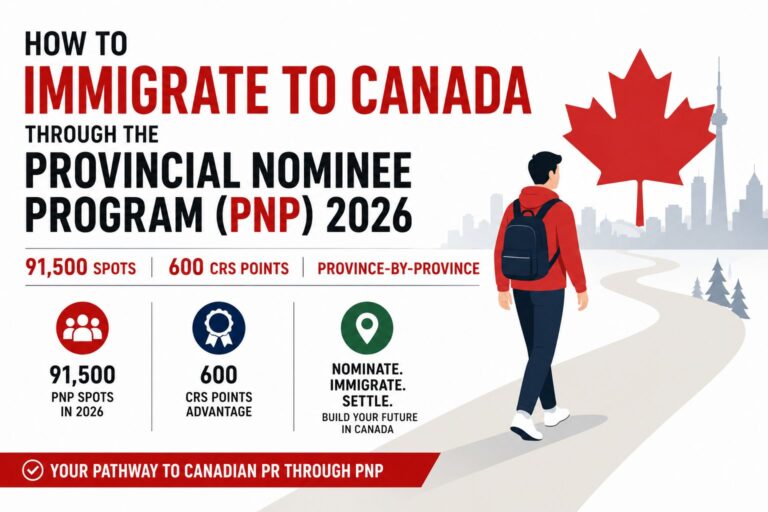
How to Immigrate to Canada Through the Provincial Nominee Program (PNP) 2026: 91,500 Spots,…
On that date, Immigration Minister Lena Metlege Diab stood at the Canadian Club in Toronto and announced the most significant restructuring of Express Entry since the program’s launch in 2015. Five brand-new occupational categories were added to the existing five, bringing the total to ten active category-based draws for 2026. The Agriculture and Agri-Food category was retired. And the general all-program draws that had defined Express Entry for nearly a decade were largely replaced by targeted draws aimed at specific occupational groups Canada urgently needs.
The practical impact has been dramatic. Physicians are now receiving Invitations to Apply with CRS scores as low as 169. Senior managers received their first dedicated draw in March 2026 with a cut-off of 429. The category-based selection model solves the problem of general CEC cut-offs sitting around 508 by allowing the government to draw from a sub-pool — if your occupation is in a priority category, IRCC can invite you at a score far lower than the general cut-off because you are not competing against the entire pool, only against other candidates in your category.
This guide will walk through everything you need to understand the 2026 Express Entry system, identify whether you qualify, calculate your probable CRS score, and submit an application that has a realistic chance of receiving an Invitation to Apply within the next 6-12 months. We will cover all three federal programs managed through Express Entry, the Comprehensive Ranking System scoring framework, all ten active 2026 categories with their specific occupation lists, the dramatic shift in draw types throughout 2025-2026, and the step-by-step application process from credential assessment to permanent resident card.
But first, you need to understand what Express Entry actually is, because the confusion between Express Entry and Canada’s other immigration pathways is the most common source of failed applications.
What Express Entry Actually Is
Express Entry is not a single immigration program. It is an application management system that handles candidates for three separate federal economic immigration programs:
- Federal Skilled Worker Program (FSWP): For skilled workers with foreign work experience
- Federal Skilled Trades Program (FSTP): For skilled trades workers
- Canadian Experience Class (CEC): For workers with Canadian work experience
If you are considering Canadian permanent residency and your work experience falls into TEER 0, 1, 2, or 3 of Canada’s National Occupational Classification (NOC) system, Express Entry is almost certainly your primary pathway.
The mechanics are straightforward. You determine eligibility for one of the three federal programs. You create an Express Entry profile through IRCC’s online portal. Your profile is scored under the Comprehensive Ranking System, which assigns points based on age, education, language ability, work experience, and other adaptability factors. Your profile enters the Express Entry pool and remains active for 12 months. IRCC conducts regular rounds of invitations, selecting candidates from the pool based on their CRS scores and other criteria. If your profile is selected, you receive an Invitation to Apply (ITA) for permanent residence. You then have 60 days to submit a complete permanent residence application with all supporting documentation. Processing typically takes 6 months from application submission to PR confirmation.
The system has three significant features that distinguish it from other immigration pathways. First, you do not need a Canadian job offer to qualify (though one improves your CRS score). Second, processing is dramatically faster than most other pathways — 6 months federal processing versus 18-30 months for some alternatives. Third, the entire system is points-based, which means improving any single factor in your profile can shift your position in the pool meaningfully.
The Three Federal Programs Explained
Federal Skilled Worker Program (FSWP)
The FSWP is designed for foreign workers with skilled occupational experience (TEER 0, 1, 2, or 3) who do not have Canadian work history. Minimum requirements include:
- At least 1 year of continuous full-time skilled work experience (or equivalent part-time) in the past 10 years
- Language ability at minimum CLB 7 in English (IELTS, CELPIP) or French (TEF, TCF)
- Educational credential assessment (ECA) if your education is from outside Canada
- Minimum 67 points on the FSW selection grid (separate from the CRS score)
- Settlement funds of approximately CAD $14,690 for a single applicant (more for families)
The FSWP is the primary pathway for foreign-trained professionals applying from outside Canada — doctors, nurses, engineers, IT specialists, finance professionals, teachers, and other skilled workers.
Federal Skilled Trades Program (FSTP)
The FSTP targets skilled trades workers with specific occupational backgrounds. Eligible trades include:
- Major Group 72: Industrial, electrical, and construction trades
- Major Group 73: Maintenance and equipment operation trades
- Major Group 82: Supervisors and technical jobs in natural resources, agriculture, and related production
- Major Group 83: Occupations in natural resources and agriculture
- Major Group 92: Processing, manufacturing and utilities supervisors and central control operators
- Major Group 93: Central control and process operators and aircraft assembly assemblers
- Minor Group 632: Chefs and cooks
- Minor Group 633: Butchers and bakers
Minimum requirements include:
- At least 2 years of skilled trades work experience in the past 5 years
- Language ability at minimum CLB 5 (speaking, listening) and CLB 4 (reading, writing)
- Either a valid job offer of at least 1 year, or a certificate of qualification from a Canadian provincial/territorial authority
The FSTP is the primary pathway for skilled trades workers including welders, electricians, plumbers, carpenters, heavy equipment operators, chefs, and similar occupations. See our detailed coverage of [Construction Site Supervisor Jobs in Canada with Visa Sponsorship] for trades-specific guidance.
Canadian Experience Class (CEC)
The CEC is designed for workers who have already accumulated skilled work experience in Canada, typically through Post-Graduation Work Permits (PGWP) for international graduates or LMIA-backed work permits. Minimum requirements include:
- At least 1 year of full-time (or equivalent part-time) skilled work experience in Canada in the past 3 years
- Work experience at TEER 0, 1, 2, or 3
- Language ability at minimum CLB 7 for TEER 0/1 or CLB 5 for TEER 2/3 occupations
- No settlement funds requirement (because you are already established in Canada)
The CEC is the fastest single pathway from temporary status to permanent residency in Canada. Workers who arrive on study permits, complete Canadian education, work for 12+ months under PGWP, and apply through CEC frequently obtain PR within 24-36 months of first arrival in Canada.
The CRS Scoring System Explained
The Comprehensive Ranking System assigns points across four major categories, with a maximum total of 1,200 points.
Core Human Capital Factors (Maximum 500 points without spouse / 460 with spouse)
- Age: Maximum 110 points (peaks at 20-29 years old)
- Education: Maximum 150 points (peaks at master’s or PhD)
- Language proficiency (first official language): Maximum 136 points (peaks at CLB 10+)
- Canadian work experience: Maximum 80 points (peaks at 5+ years)
Spouse or Common-Law Partner Factors (Maximum 40 points)
- Spouse’s education, language, and Canadian work experience contribute additional points
Skill Transferability Factors (Maximum 100 points)
- Combinations of education plus language ability
- Combinations of education plus Canadian work experience
- Combinations of foreign work experience plus language ability
- Combinations of foreign work experience plus Canadian work experience
- Certificate of qualification plus language ability (for trades)
Additional Points (Maximum 600 points)
- Provincial nomination: 600 points (essentially guarantees an ITA)
- Arranged employment (valid Canadian job offer): 50 or 200 points depending on occupation
- Canadian education: 15-30 points (1-2 years vs 3+ years)
- French language ability: 25-50 points (with sufficient English ability)
- Sibling in Canada: 15 points
The strategic implication of this scoring system is that improving any single factor can meaningfully change your overall position. Workers focused only on overall CRS without analysing which specific factors are dragging them down often miss easy improvement opportunities.
The 2026 Paradigm Shift: Category-Based Selection
This is the development that has fundamentally changed Express Entry strategy for 2026 and beyond.
For most of Express Entry’s history, draws operated through “general rounds” that invited the highest-ranking candidates from the entire pool regardless of occupation. CRS cutoffs in general draws typically ran between 470 and 550, putting permanent residency out of reach for many candidates without exceptional profiles.
In May 2023, IRCC introduced category-based selection, which allowed targeted draws inviting candidates whose primary work experience fell into specific economic priority categories. The 2023-2024 categories included healthcare, STEM, trades, transport (eventually retired and re-added), agriculture, and French language proficiency.
For 2026, the system has been dramatically expanded. Immigration Minister Lena Metlege Diab announced the 2026 category overhaul on February 18, 2026, at the Canadian Club in Toronto. The announcement confirmed Canada’s International Talent Attraction Strategy — a deliberate shift from high-volume general selection toward targeted recruitment of specific occupational groups.
The 2026 active categories are: French language proficiency, Healthcare and social services occupations, Science, Technology, Engineering and Math (STEM) occupations, Trade occupations, Education occupations, Physicians with Canadian work experience, Senior managers with Canadian work experience, Researchers with Canadian work experience, and Skilled military recruits. Five of these are brand new for 2026: Physicians, Researchers, Senior Managers, Transport, and Military. The Agriculture and Agri-Food category was retired.
The practical impact has been transformative. There may be no general draw in 2026. The general draw category has not been used since April 2024, replaced almost entirely by category-based selection.
The 10 Active 2026 Categories with Specific CRS Cutoffs
Here is the complete picture of Express Entry category-based draws for 2026.
Category 1: French Language Proficiency
The single most active category throughout 2025-2026. In 2025, the French-language category was used more than any other category. On April 15, 2026, IRCC held a category-based draw for French-language proficiency. 4,000 invitations were issued to candidates with a minimum CRS score of 419. The latest French draw on May 28, 2026 issued 4,500 invitations at a CRS cut-off score of 409.
Eligibility: NCLC 7 or higher in French (equivalent to CLB 7) plus general Express Entry eligibility.
Strategy: French ability is the single most valuable additional asset in 2026 Express Entry. Candidates with even moderate French should consider intensive French study before submitting profiles.
Category 2: Healthcare and Social Services Occupations
The February 20, 2026 healthcare draw issued 4,000 invitations at a CRS cutoff of 467, covering 37 eligible occupations spanning physicians, nurses, allied health, technicians, and social services. Healthcare category CRS cutoffs in 2025-26 ranged from 463 to 507, well below general draws sitting at 504-547.
Eligible occupations include registered nurses (NOC 31301), nurse practitioners (31302), licensed practical nurses (32101), pharmacists (31120), physiotherapists (31202), occupational therapists (31203), dentists (31110), pharmacy technicians (33103), medical lab technologists (32120), medical radiation technologists (32121), respiratory therapists (32103), home support workers (44101), psychologists (31200), social workers (41300), and 23 others.
See our detailed coverage of [Top Healthcare Jobs in Canada with Visa Sponsorship] for the full occupation list and licensing requirements.
Category 3: STEM Occupations
For workers in Science, Technology, Engineering, and Mathematics fields. Eligible occupations include software engineers, computer engineers, data scientists, mechanical engineers, electrical engineers, civil engineers, mathematicians, statisticians, and biological/chemical/physical scientists.
CRS cutoffs in 2025-2026 STEM draws typically ran 470-491.
Category 4: Trade Occupations
On April 2, 2026, IRCC held the first trades category draw of the year and issued 3,000 invitations at a CRS cutoff of 477. This single draw issued more than twice the total trades invitations issued during all of 2025. Cooks were removed from the list for 2026. The 25 remaining occupations focus on construction, industrial, and mechanical trades.
Eligible occupations include construction site supervisors (NOC 72014), electricians (72200), plumbers (72300), carpenters (72310), welders (72106), heavy equipment mechanics (72401), and similar skilled trades roles.
See our coverage of [Construction Site Supervisor Jobs in Canada with Visa Sponsorship] for the trades pathway in detail.
Category 5: Education Occupations (NEW 2026)
For workers in education-related occupations including secondary school teachers, elementary school teachers, early childhood educators, university lecturers, and college instructors. This category is new for 2026 and reflects Canada’s chronic teacher shortage particularly in rural and northern communities.
Category 6: Physicians with Canadian Work Experience (NEW 2026)
Physicians are receiving Invitations to Apply with CRS scores as low as 169 in this brand-new dedicated category. The requirements include Canadian work experience as a physician (NOC 31100, 31101, 31102) and full Express Entry eligibility.
This is the single most accessible 2026 category for those who qualify — the dramatic CRS cutoff reflects Canada’s acute physician shortage and the difficulty of attracting and retaining foreign-trained doctors.
Category 7: Senior Managers with Canadian Work Experience (NEW 2026)
Senior managers received their first dedicated draw in March 2026 with a cut-off of 429. Eligible NOC codes are within Major Group 00 (Legislative and senior management occupations).
Category 8: Researchers with Canadian Work Experience (NEW 2026)
For workers in research-focused academic and industry positions, with specific NOC codes including post-secondary research positions and specialized research roles in life sciences, social sciences, and engineering.
Category 9: Transport Occupations
For workers in transportation roles including long-haul truck drivers (NOC 73300), aircraft mechanics, railway transport operators, and similar transport sector positions. Canada’s chronic shortage of long-haul truck drivers has driven heavy investment in this category.
Category 10: Skilled Military Recruits (NEW 2026)
For Canadian Armed Forces recruits with foreign military experience and specific skill requirements. This category reflects defense recruitment priorities.
The Current Express Entry Pool
Understanding where candidates are clustered in the pool helps predict CRS cutoffs in upcoming draws.
As of May 24, 2026, the Express Entry pool includes a total of 238,847 candidates. The distribution by CRS score:
- 600+ points: Very small percentage (typically high-value profiles with provincial nominations)
- 500-599 points: 10-15% of pool
- 450-499 points: 20-25% of pool
- 400-449 points: 25-30% of pool
- Below 400 points: 30-40% of pool
The strategic implication is that target CRS scores depend heavily on which category you fall into. A general draw cutoff of 515 or higher excludes most candidates from realistic invitation. A healthcare category cutoff of 467 includes a much larger portion of the pool. A French language category cutoff of 409 opens the door for many more candidates.
Step-by-Step Application Process
Step One: Determine Your Eligibility
Before doing anything else, verify which of the three federal programs you qualify for:
- FSWP: Foreign work experience in TEER 0-3, CLB 7+ language, ECA for education
- FSTP: Skilled trades experience plus job offer or certificate of qualification
- CEC: 12+ months of qualifying Canadian work experience in TEER 0-3
Use IRCC’s “Come to Canada” tool at canada.ca to verify your eligibility before investing in documentation.
Step Two: Educational Credential Assessment
If your education is from outside Canada, submit credentials to one of IRCC’s designated organizations:
- World Education Services (WES) — most popular for general use
- International Credential Assessment Service of Canada (ICAS)
- International Qualifications Assessment Service (IQAS) — Alberta-based
- Comparative Education Service (CES) — University of Toronto
- International Credential Evaluation Service (ICES) — British Columbia
For physicians, the Medical Council of Canada is the required body. For pharmacists, the Pharmacy Examining Board of Canada (PEBC). For other regulated professions, designated bodies vary.
Processing time: 4-12 weeks. Cost: CAD $200-$300.
Step Three: Language Testing
Take an approved language test in your primary language:
- English: IELTS Academic, IELTS General Training, or CELPIP General
- French: TEF Canada or TCF Canada
Most candidates pursue both English and French testing if they have any French ability, because French language points provide significant CRS boosts (25-50 points) and French category eligibility.
Processing time: 2-3 weeks after test. Validity: 2 years.
Step Four: Create Your Express Entry Profile
Through IRCC’s online portal at canada.ca/en/immigration-refugees-citizenship/services/immigrate-canada/express-entry.html, create your Express Entry profile. The profile requires:
- Personal identification
- Passport information
- Educational credentials with ECA report numbers
- Language test results
- Work experience documentation
- NOC code identification for each work experience entry
- Spouse/family information
- Settlement funds attestation
Submission is free at this stage. Profiles remain active for 12 months and are automatically evaluated against every draw during that period.
Step Five: Receive Invitation to Apply (ITA)
Wait for your profile to be invited. The timeline depends entirely on your CRS score and which categories you qualify for. Candidates eligible for high-volume category-based draws (French, healthcare, trades) typically receive ITAs within 1-6 months. Candidates relying on general draws may wait indefinitely with current trends.
Step Six: Submit Complete Permanent Residence Application
Within 60 days of receiving an ITA, you must submit a complete electronic permanent residence application including:
- Detailed personal history and travel documents
- Police clearance certificates from every country where you have resided for 6+ consecutive months since age 18
- Medical examination from an IRCC-approved panel physician
- Biometrics (fingerprints and photograph)
- Detailed employment reference letters
- Marriage/divorce/birth certificates as applicable
- Educational credentials with certified translations if not in English or French
- Federal application fee of CAD $1,525 per adult, $260 per dependent child
- Right of Permanent Residence Fee of CAD $575 per adult
Step Seven: IRCC Processing
Express Entry permanent residence applications typically process in 6 months. During this period, IRCC verifies all documentation, conducts security and background checks, and confirms eligibility against the program requirements.
Step Eight: Confirmation of Permanent Residence and Landing
If approved, you receive a Confirmation of Permanent Residence (COPR) document. You then travel to Canada and present the COPR at a port of entry, where a Canadian Border Services Agency officer processes your landing and grants permanent resident status.
Your physical PR card arrives by mail 4-6 weeks after landing.
Strategies to Improve Your CRS Score
Most candidates do not maximize easily achievable score improvements before submitting their profiles. Common high-impact improvements include:
Improve language test scores. Moving from CLB 7 to CLB 9 typically adds 30-50 CRS points across language and skill transferability factors. The same test can be retaken, and most candidates score higher after preparation.
Add French language testing. Even basic French at NCLC 4 adds 6 CRS points. NCLC 7 adds 25-50 CRS points depending on your English level. French testing also enables the high-volume French category-based draws.
Pursue provincial nomination. A provincial nomination adds 600 CRS points, essentially guaranteeing an ITA. See our coverage of [How to Immigrate to Canada Through the Provincial Nominee Program 2026] for the complete PNP pathway.
Secure a valid Canadian job offer. A qualifying job offer adds 50 or 200 CRS points depending on occupation.
Complete Canadian education. One year of Canadian post-secondary education adds 15 CRS points. Two or more years adds 30 CRS points. International students who complete Canadian degrees are positioned exceptionally well.
Bring a sibling in Canada. Having a Canadian citizen or permanent resident sibling adds 15 CRS points.
Time your application strategically. Age points peak at 20-29 and decline after 30. Younger candidates should not delay; older candidates should not assume they cannot succeed but should focus on other improvements.
Common Mistakes That Destroy Applications
Misrepresenting your NOC code. The NOC code you select must accurately reflect your actual duties. IRCC scrutinises NOC claims rigorously, particularly for category-based selection. Misrepresentation results in application refusal and potential 5-year ban from Canadian immigration.
Inadequate work experience documentation. Reference letters must include specific job titles, NOC code matching, detailed duties, hours worked per week, salary information, and signatures from authorized representatives. Generic letters fail at the document review stage.
Missing the 60-day ITA deadline. After receiving an ITA, you have 60 days to submit a complete PR application. Missing this deadline voids your invitation and returns your profile to the pool with no guarantee of future selection.
Submitting incomplete medical examinations. Medical examinations must be conducted by IRCC-approved panel physicians using IRCC’s specific protocols. Standard medical certificates do not satisfy IRCC requirements.
Ignoring criminal history disclosure. Failure to disclose minor offenses, traffic violations resulting in court appearances, or previous immigration refusals results in misrepresentation findings. Always disclose everything; rehabilitation is possible for many issues that would otherwise result in inadmissibility.
Assuming Express Entry is your only option. If your CRS score will not realistically meet category thresholds, Provincial Nominee Programs, Atlantic Immigration Program, and Rural Community Immigration Pilot all offer alternative pathways. Strategic candidates pursue multiple pathways simultaneously.
Building applications around outdated information. The 2026 categories announced February 18, 2026 fundamentally changed Express Entry strategy. Articles from 2023-2025 describe systems that have since been modified or retired. Verify all information against current IRCC publications.
Frequently Asked Questions
How much does the entire Express Entry process cost?
Plan for CAD $3,000-$5,000 total per single applicant. Breakdown: Educational Credential Assessment ($200-$300), language testing ($300-$400), federal application fees ($1,525 plus $575 Right of Permanent Residence Fee), biometrics ($85), medical examination ($300-$500), police clearance certificates (varies by country, typically $50-$200 total), translations and certifications ($200-$500). Family applications add similar amounts per family member.
How long does Express Entry take from start to finish?
Plan for 12-18 months total. Pre-application preparation: 3-6 months (ECA, language testing, profile creation). Time in pool waiting for ITA: 1-12 months depending on category eligibility. PR application processing: 6 months. Total: 12-18 months from beginning to permanent resident card.
Do I need a Canadian job offer to apply through Express Entry?
No. None of the three federal programs require a Canadian job offer, though a valid job offer adds 50-200 CRS points and can be decisive for borderline profiles.
Can I apply through Express Entry from outside Canada?
Yes. The FSWP and FSTP are specifically designed for foreign applicants. CEC requires Canadian work experience but the application can still be submitted from outside Canada.
What’s the difference between Express Entry and PNP?
Express Entry is a federal application management system handling three federal programs. PNP is a network of provincial nomination programs. The two integrate when provinces issue Enhanced (Express Entry-aligned) nominations, which add 600 CRS points to your Express Entry profile.
What if my CRS score is too low?
Multiple strategies exist. Improve language test scores (often the highest-impact improvement). Add French language testing. Pursue Provincial Nominee Program nomination. Secure a Canadian job offer. Complete Canadian education. Accumulate Canadian work experience. Most candidates who initially have low scores can improve to competitive levels within 12-24 months.
Can I bring my family with me?
Yes. Express Entry applications include spouses and dependent children. Spouses can apply for open work permits while your PR application is processed. Children attend Canadian schools at no cost.
Do I need an immigration consultant?
For straightforward profiles with no complications, IRCC’s online system is designed for self-application. For complex situations (previous refusals, criminal history, complex family structures, business immigration, regulated profession recognition), a Regulated Canadian Immigration Consultant (RCIC) or Canadian immigration lawyer provides meaningful value.
What happens if my profile expires without an ITA?
Your profile remains in the pool for 12 months. If not selected within that period, you can create a new profile and re-enter the pool. Your profile data carries forward through profile creation but the 12-month clock resets.
Which category gives me the best chance?
The category that matches your actual work experience. Categories are not optional — you cannot choose to enter a category where you don’t qualify. Match your NOC code to the active 2026 categories and pursue accordingly.
Will the 2026 categories remain in 2027?
Likely yes, with potential modifications. The 2026 categories reflect Canada’s chronic labour shortages, which are not expected to resolve quickly. Annual category reviews by the Immigration Minister may add, remove, or modify specific categories based on labour market data.
Can I work in Canada while waiting for Express Entry?
Yes, if you have a separate work permit (LMIA-backed, IEC for participating nationalities, Post-Graduation Work Permit, or other authorized work permit). The Express Entry application itself does not provide work authorization until permanent residency is granted.
What is the most strategic single move I can make right now?
Take a strong English language test (target CLB 9+) and consider French testing even if you have only basic ability. Language test improvements provide the highest CRS point return per dollar invested of any improvement strategy.
Start Your Express Entry Application Today
Canadian Express Entry remains the single most accessible legitimate immigration pathway for skilled foreign workers in 2026, and the 2026 category-based selection model has dramatically expanded the realistic pool of candidates who can succeed. With ten active categories, CRS thresholds ranging from 169 for physicians to 515+ for general draws, and 65,000+ ITAs issued so far in 2026, the system is actively recruiting workers across healthcare, trades, STEM, education, transport, research, management, and several other priority sectors.
The fastest way to begin the Express Entry process is to immediately complete the three foundational steps: Educational Credential Assessment, language testing, and profile creation. Together these typically take 3-6 months and constitute the entire pre-application investment required.
For workers seeking Canadian job offers to support their Express Entry applications — particularly through LMIA-backed positions that qualify for arranged employment points or build qualifying Canadian work experience for the Canadian Experience Class — Indeed Canada lists positions across every province and sector with active visa sponsorship.
👉 Click here to find Canadian jobs that support Express Entry applications: Visa Sponsorship Jobs in Canada — Indeed Canada
For sector-specific guidance on Express Entry pathways most relevant to your situation:
- [Top Healthcare Jobs in Canada with Visa Sponsorship] — for the healthcare category-based draws
- [Construction Site Supervisor Jobs in Canada with Visa Sponsorship] — for trades category eligibility
- [How to Immigrate to Canada Through the Provincial Nominee Program 2026] — for the 600-point boost that essentially guarantees an ITA
- [Jobs in Canada for UK Citizens 2026] — for British professionals considering the Express Entry route
- [Unskilled Jobs in Canada with Visa Sponsorship 2026] — for context on alternative pathways outside Express Entry
Before submitting an Express Entry profile, complete these foundational steps:
- Educational Credential Assessment through WES, ICAS, IQAS, CES, or ICES (4-12 weeks)
- Language testing — IELTS, CELPIP, TEF, or TCF (2-3 weeks)
- Identify your accurate NOC code from canada.ca/noc
- Verify eligibility for FSWP, FSTP, or CEC
- Document your work experience comprehensively with detailed reference letters
- Calculate your CRS score honestly using IRCC’s Comprehensive Ranking System Calculator
- Identify which 2026 categories you qualify for
- Confirm you can demonstrate settlement funds (CAD $14,690 for single applicant)
The Express Entry system processes 230,000+ candidates simultaneously, with roughly 100,000 ITAs issued annually across all categories. The Canadian government has explicitly committed to economic immigration as the primary driver of Canada’s permanent resident intake. The 2026-2028 Immigration Levels Plan maintains strong economic immigration targets. The pathway is genuinely open, well-defined, and operates on predictable timelines.
The single biggest barrier between you and Canadian permanent residency is not the system’s difficulty — it is the application you have not yet submitted. Your profile sits in the pool for 12 months. Every category-based draw that occurs during those 12 months is an opportunity to receive your invitation. The strategic move is to enter the pool with the strongest possible profile as soon as possible.
For the most current draw information and category eligibility details, refer directly to IRCC at canada.ca/express-entry, which publishes every draw result, category update, and program change.